Showing posts with label Trappist Ale. Show all posts

February 9, 2014

Engelszell Gregorius Trappistenbier

Brewed By: Stift Engelszell Trappistenbier-Brauerei in Engelhartszell an der Donau, Austrian
Purchased: 11.2oz/333ml bottle bought at Binny's in Chicago, IL; 2014 (2013 Vintage)
Style/ABV: Belgian Dark Strong Ale, 9.7%
Reported IBUs: ???

So I had a really cool Engelszell glass, and then I broke it. FML. Anyway...about Stift Engelszell:
Stift Engelszell is the only Trappist monastery in Austria, and was founded in 1293 by Bishop Bernard (Wernhart), and was technically settled in 1295. The abbey suffered spiritual and financial decline during the Protestant Reformation, until it started to receive support from the Wilhering Abbey from 1618 onward. In 1699, the abbey suffered a disastrous fire, and from 1720 to 1746 the abbey fell into the hands of various administrators. In 1746, Leopold Reichl, the last of Engelszell's abbots, began to rebuild the abbey. In 1786 Engelszell was dissolved by Emperor Joseph II.

According to Wikipedia, in 1925 Engelszell was re-founded as a Trappist monastery by refugee German monks who were expelled from the Oelenberg Abbey in Alsace after World War I. In 1931, Engelszell was again elevated to the rank of an abbey, but in 1939, the abbey was confiscated by the Gestapo. Four monks were sent to the Dachau Concentration Camp, and others were imprisoned or drafted. At the end of the war, only a third of the community returned to the abbey. Sine 1995, the abbot has been Marianus Hauseder, and there are nine or so monks in the community.

In May 2012, the abbey was approved by the International Trappist Association to become the 8th producer of Trappist beer. For more information, check out the abbey's website, or this lovely Wikipedia article.
I had this beer on tap, and I thought it was really good, so let's see how she holds up in the bottle. The Engelszell Gregorius Trappistenbier is a "dark triple" punching in at 9.7% ABV. This one is brewed with water, malted barley, honey, hops, and yeast. My bottle has a bottle-on date of 2013/09.
Engelszell Gregorius Trappistenbier

The beer pours into a hazy reddish-purple/brown body, kicking up three fingers of bready, dense, brown/tan/khaki head. The head doesn't hang along for long, quickly fading into a finger of sustaining suds. There's some glossy alcohol legs and minimal lacing. The beer looks to be hazy, and has that typical Dubbel/Dark Strong body that is probably a hazy reddish-orange color in bright light.

The aroma is a nice blend of dark fruits, medicinal funk, leather, and some Belgian Yeast spice. I'm getting raisins, plums, prunes, some purple grape, leather, peppery clove, medicinal funk, hospital room (<- I know, right?), and lots of Belgian Yeast goodness. Namely the clove, hints of peppery spice, and medicinal funk. It's fruity and earthy, and it has a rustic edge much like the Benno did. 

This is surprisingly nuanced in the taste, with rustic leather and Belgian funk. There are tons of earthy notes and medicinal spice, with leather, clove, hospital room and bandages, peppery spice, and some hints of grain. The beer also features lots of earthy and complex dark fruits, ranging from plums, prunes, raisins, and some darker, overripe cherries. There's definitely some aspects of a stereotypical Quad, with hints of banana, honey, white sugar, and overripe fruits. The booze is well-masked. There's some subtle burnt sugars and caramel in the mix as well.

This is a full-bodied beer, but it's on the lighter side of full-bodied. Palate depth and duration are good, and the complexity is nuanced but present. It's well carbonated and hides the 9.7% very well. It's very earthy and rustic, featuring big spice, leather, and medicinal funk characters, followed by dark fruits, and then some interesting caramel sugars. I like this a lot...particularly as a beer to pair with food. It's very vinous as well. Up front: Leather, medicinal spice and hospital room, and dark fruits (raisin/plums/figs); mid palate rolls into clove, some bready/grainy notes, more spice and funk, a little hop bitterness; back end is fruity, vinous, earthy, leather, dry....nice.

Rating: Above-Average (4.0/5.0 Untappd)

I'm feeling a Light Above-Average 
on this. This is big, complex beer, and it has a lot going on. I would pair this with strong cheeses, grilled meets, duck, rustic foods, potatoes, carrots, peppery turkey, and big soups and stews. It's a very solid brew, and it's pretty damn available...I like that. I give it a lukewarm recommendation, and yeah. 

Random Thought: I've never been looking forward to Monday more than this weekend! Hoory!

January 21, 2014

Engelszell Benno Trappistenbier

Brewed By: Stift Engelszell Trappistenbier-Brauerei in Engelhartszell an der Donau, Austrian
Purchased: 11.2oz/333ml bottle bought at Binny's in Chicago, IL; 2014 (2013 Vintage)
Style/ABV: Trappist Ale/Belgian Dubbel, 6.9%
Reported IBUs: ???

Tonight's beer is unique enough, and I was happy to find it sitting on shelves in Binny's. The beer came in one of those holiday gift packs, and the gift pack included two bottles of beer and a sexy Engelszell glass. Without further ado, let's dig into Austria's Trappist brewery. About Stift Engelszell:
Stift Engelszell is the only Trappist monastery in Austria, and was founded in 1293 by Bishop Bernard (Wernhart), and was technically settled in 1295. The abbey suffered spiritual and financial decline during the Protestant Reformation, until it started to receive support from the Wilhering Abbey from 1618 onward. In 1699, the abbey suffered a disastrous fire, and from 1720 to 1746 the abbey fell into the hands of various administrators. In 1746, Leopold Reichl, the last of Engelszell's abbots, began to rebuild the abbey. In 1786 Engelszell was dissolved by Emperor Joseph II.

According to Wikipedia, in 1925 Engelszell was re-founded as a Trappist monastery by refugee German monks who were expelled from the Oelenberg Abbey in Alsace after World War I. In 1931, Engelszell was again elevated to the rank of an abbey, but in 1939, the abbey was confiscated by the Gestapo. Four monks were sent to the Dachau Concentration Camp, and others were imprisoned or drafted. At the end of the war, only a third of the community returned to the abbey. Sine 1995, the abbot has been Marianus Hauseder, and there are nine or so monks in the community.

In May 2012, the abbey was approved by the International Trappist Association to become the 8th producer of Trappist beer. For more information, check out the abbey's website, or this lovely Wikipedia article.
The Engelszell Benno Trappistenbier is a Trappist Dubbel that punches in at 6.9% ABV, and is sold at the brewery or at their online store. Evidently it gets imported into the states as well via bottle, and I've had the Engelszell Gregorius on tap. It was tasty. The Benno (here now pronounced "Beano") is brewed with water, malted barley, honey, hops, and yeast. 
Engelszell Benno Trappistenbier 

The Benno pours into a hazy, honey-amber/dark orange/brownish body, and kicks up three fingers of orange/amber-tinted head. The head is dense and fluffy like a wheat beer, and as it departs there is some nice lacing. Head retention is great. Bright light confirms the swampy and murky but radiant orange beer. It's reminiscent of a Dubbel. There's some nice carbonation storming upwards in this.

This has a really nice, rustic aroma. The aroma is pretty raw and funky, with some dusty leather, Belgian yeast spice phenol, banana, bubblegum, clove, light cinnamon and ginger, wheat malt, some toast, and some peppery spice phenol. There is some fruit aroma lurking in here. Along with the banana, white sugar, and wheat is some cherry, peach, golden raisin, and stone fruit.  

I did pour the yeast into my glass...but I've let it settle for a bit, and I'm still getting a lot of medicinal and herbal twang. This one tastes quite peppery, with tons of peppery phenol, cinnamon, cumin, some Saison-like peppery phenol, and some nice funky leather. I'm sort of reminded of the wacky Saisons from Fantôme, and that's not a bad thing by any stretch. This one is bitter too, with good floral bitterness, bitter peach, and some citrus. The honey does show up, mostly in the back and as part of the body.

This beer is oddly complex, and again, I'm reminded of a Fantôme Saison with the bitter medicinal/herbal/peppery kick, and hints of Belgian funk and leather. This has no wild yeast or Brett in it (as far as I know or can tell). Palate depth is good, complexity is good...it drinks medium-bodied with good carbonation, and the 6.9% is hidden minus some mild warming. You get fruity peaches, Saison-like floral notes, some stone fruit and citrus, and burgeoning phenol and spice up front; the middle rolls into huge phenol and spice, with tons of herbal/medicinal, pepper, funky Belgian yeast, some leather, earthy; the back end continues with the bitter, medicinal, peppery funk...fade to dry. Honey character in the back and in the mouthfeel. Pretty unique...

Rating: Average (3.0/5.0 Untappd)

I really don't know...I'm gonna go with a Light
 Average
, but honestly, I think I might rate this higher and I'll have to revisit this. This is an oddly compelling and unique beer...it's very earthy, spicy, herbal/medicinal, and it has that rustic and wild Fantôme funk with unchecked Belgian yeast and dusty leather. It's kind of...an ugly duckling beer, like a Rottweiler or Pitbull. This beer really does have a ton of character, and the biggest sin here is calling it a Dubbel. A Dubbel...this is not. There's no plums or brown sugar or any of that shit. Yup. I'm gonna quit now, but definitely pick this up and hey, let me know what you think if you happen to read this. Food pairings: rustic, peppery foods. Treat this like a peppery Saison. Peppery turkey, chicken, duck, potatoes, carrots, etc. This is like some Medieval times beer. Recommended. 

Random Thought: I cannot emphasize enough how intrigued I am by this beer...and the Engelszell Gregorius isn't too shabby either. I have another bottle I'm camping on, and I'll check this out again in a few months for a possible re-review. 

July 16, 2013

Trappistes Rochefort 10

Brewed By: Brasserie Rochefort in Rochefort, Belgium  
Purchased: 11.2 oz bottle bought at Binny's in IL; 2013 
Style/ABV: Belgian Dark Strong Ale, 11.3% 
Reported IBUs: 27

I wonder if the glass gave away tonight's second beer. As a beer geek/nerd, I'll stop by my local bottle shops to see if there is anything new on the shelves. For the past couple of weeks, I've been seeing the Rochefort 10 just about everywhere. I figured it was a sign, and grabbed a bottle. 

The Abbey Rochefort is one of the eight Trappist BreweriesThe brewery's website is only available in French or Dutch, but you can use Google translate. Or you can half-ass it like me, and roll over to Wikipedia. The brewery is located inside the Abbey of Notre-Dame de Saint-Rémy, and has been brewing beer since 1595. This beer is sold to support the brewery and for charitable causes. If you roll over to Merchant Du Vin's website, you can also get some info. According to them, the Abbey of St-Remy was founded in 1230, and the monks began to brew beer in 1595. 

Tonight's beer, the Rochefort 10 or the "Blue Cap," was originally brewed in the late 1940s or early 1950s. Clocking in at 11.3% and 27 IBUs, this beer is described as a typical Belgian Dark Strong Ale. This is one of my absolute favorite styles of beer, so let's see how this stacks up.
Trappistes Rochefort 10 

Wow...this beer does not mess around. This pours into a dark, prune-colored body. We're talking raisin/prune-brown, with some hints of purple/black. The beer also kicked up a finger of tan/khaki head, and there was some nice sediment/yeast at the bottom of the bottle. In bright light this beer is a swampy dark brown color. This is a trappist beer that looks like the depths of hell. The head is hazy and khaki-colored, and looks exactly how it is supposed to for the style.

The aroma on this is surprisingly earthy....I'm getting dense malt, and tons of chalky dark fruits: prunes, raisins, apricots, dates, plums, figs, grapes. There's a TON of leather on the nose, along with some port wine, and lots of underlying booze. There's also a hint of spice.

Wow...this beer absolutely blasts your palate with a super rich/dense mouthfeel that borders on chocolate/milkshake-like thickness. There's the bar, and there's this...this beer is the bar. You get rich, creamy, chocolate/shake mouthfeel up front; that rolls into huge clove, creamy body, tons of peppery spice and clove, huge malty esters, and tons of earthy leather and dark fruits. Namely raisins, prunes, and some plums/grape. There's also some hints of rum in here, along with very mild buttery/tannin/oak from who knows where. There's a dusty/chalky thing going on here, and the whole thing has Stout-like thickness but wine-like vinous qualities. This isn't going for refined like the Corsendonk Pater...no sir. This beer is raunchy as hell, and super aggressive.

There are Stouts that would blush in the presence of this beer. At 11.3%, you expect big things. And many Quads/Dark Strongs have pull...but not like this. This is a full-bodied, dense beer. I'm talking milkshake dense. Despite the density, this beer is drinkable thanks to a creamy body, tons of carbonation, and some nice bitterness on the back end. Palate depth and complexity are outstanding. This would be a wonderful beer to sip on in the winter....huge cream/clove/peppery spice up front, followed by big leather; that rolls into buttery oak, bitterness, and dark fruits; the back end trails off with some hop bitterness, wheat, boozy complexity, chalk/dust. The whole thing just feels earthy and raw. There's a rustic edge to this beer.

Rating: Divine Brew (5.0/5.0 Untappd)

This is a hell of a beer. Easily a Strong Divine Brew. This is a beer that defines exemplary Belgian Dark Strongs. I wouldn't hesitate to pick this up again, and this seems like a great candidate for cellaring. You could pair this beer with strong cheeses, cheese and meats, duck, 
grilled lamb, dry chocolate cake, truffles, dark sauces, and maybe even something like mussels or calamari. I know this beer is kind of pricey at around 7 or 8 bucks a bottle, but it is worth it. 

Random Thought: Someday I'll have to do a blind tasting between the Trappist Dark Strong Ales. Of course, I'll need to get my hands on some Westy 12 first...

November 2, 2012

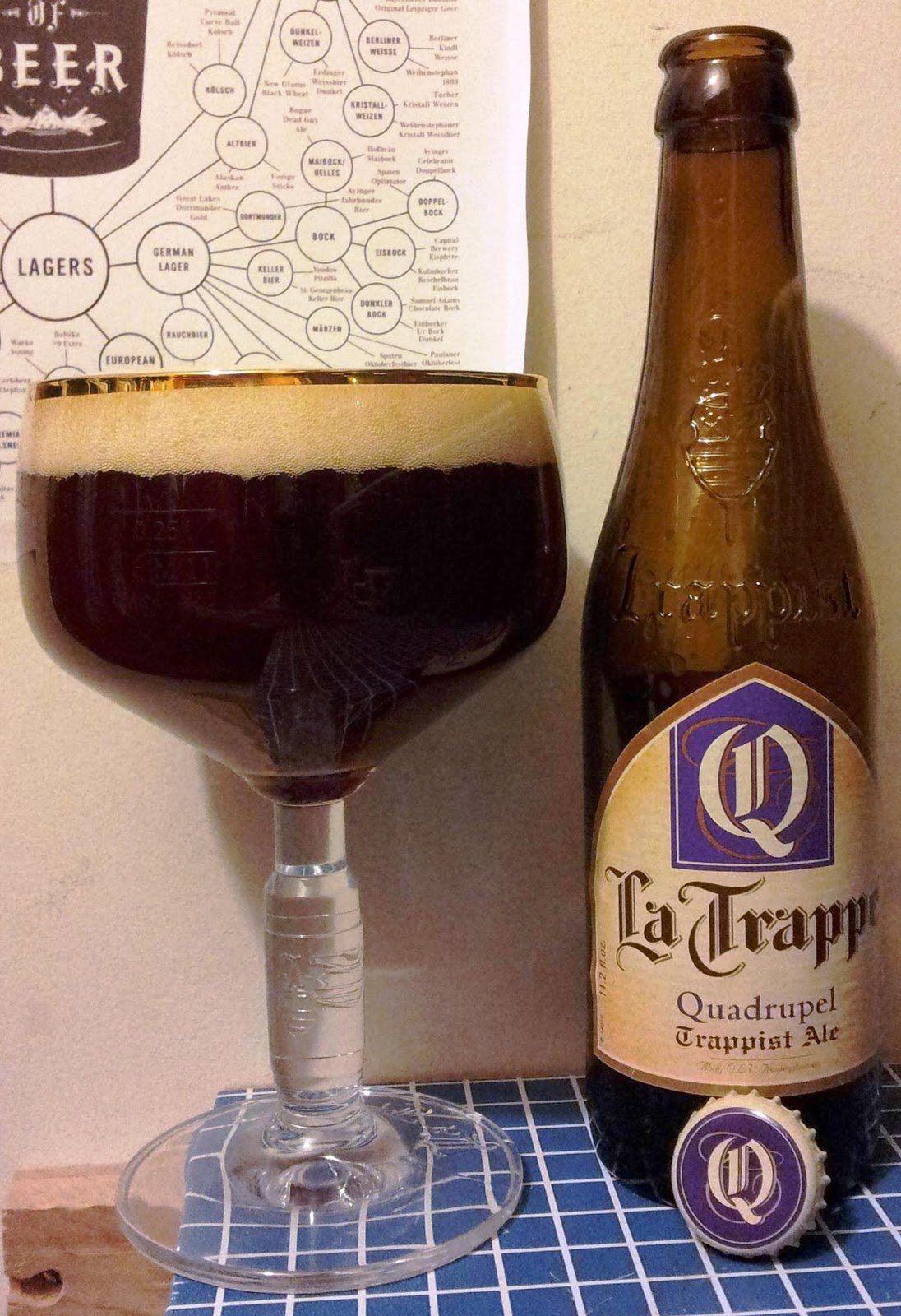
La Trappe Quadrupel

Brewed By: De Koningshoeven (Bavaria - Netherlands) in Berkel-Enschot, Netherlands   
Purchased: 11.2 oz bottle from a 4-pack set bought at Binny's in IL; 2012 
Style/ABV: Belgian Dark Strong Ale, 10.0% 
Reported IBUs: ?

I love these easy reviews...tonight, I continue my adventure with La Trappe. About La Trappe:
La Trappe has a lonnnng history. The B.V.M. Koningshoeven Abbey was founded in 1880 by the abbot Dominicus Lacaes of the Trappist monastery Sainte-Marie-du-Mont on the Mont Des Cats. At the time, there was anti-church legislation in France, and the monasteries were being threatened. The monks of the Mont des Cats were prepared to leave the country, and Sebastianus Wyart was sent to find a place to stay if they had to leave. Wyart found "the Koningshoeven" or the Royal Farms, near Tilburg, in the village of Berkel-Enschot, in the Netherlands. While the French government never cracked down, the monks still moved to Koningshoeven. In 1884, the leading abbot, Nivardus Schweykart, decided to start a small brewery to sustain the monastery. After World War I, production of beer at the brewery increased rapidly. In 1968, the brewery expanded into a mid-sized brewery, and in 1985 the brewery started exporting beer. In 1991, La Trappe Quadrupel is produced for the very first time. With that said, you should check out the official history page on the website, or even skim through the Wikipedia article on the brewery.
Tonight's beer, La Trappe Quadrupelis the strongest beer made by La Trappe. This is a fat, warming beer, clocking in at 10.0% ABV.  There's not a ton of info on the website, so you can supplement it with the BJCP's style guidelines. Let's pour this thing.
La Trappe Quadrupel

The beer pours a raisin-bronze color in low light, with 2 fingers of fluffly, golden-tinted head. The beer is hazy and murky, and all the good stuff you expect with something bottle conditioned. When held to bright light, the beer is a hazy, golden/amber color. You can see quite a bit of carbonation rising upwards, and like yesterday's Isid'or, there is about a centimeter of head just hanging around. It's not a bad looking Trappist ale.

The aroma on this is huge. Right up front I get huge, sweet, boozy fruits. There's also a lot of clove on this, with big spice dominating the aroma. I'm getting more of that apple and pear, but also some overripe banana, cherries, golden raisins, hints of plums, and some grapes. There's some toffee and bready notes on the nose as well.

This really drinks like a dialed up Isid’or, with a lot more boozy fruit kick. The booze is never overwhelming or hot, it's present in the most subtle and sinster way. It's typical for the style. Along with the big clove, pear, and apple, you get a blast of pils malts. But you also get some big overripe bananas, some cherries, hints of plums, and some raisin/grape note. There's a rum note in here as well, as the booze plays off the giant clove; maybe some allspice. Reaching for creative tasting notes...I can pull out some funky apricot and some bubblegum.

I really like this beer. This is boozy and warming, but the alcohol is subtle and brings no aggressive heat. This is refined stuff. It's slightly oily, with hints of powdery carbonation, and a full-bodied mouthfeel. It's actually very smooth, nevertheless, and drinks incredibly well. I could kill a bomber of this. Palate depth is wonderful, and this kicks up the complexity a notch from the Isid'or. Up front you get creamy carbonation, boozy fruits, cherries, overripe bananas, apples, pears; this rolls into spice, more fruits, perfume, sugars; the back end is lingering sugars, spice, and fruit. There are hints of toffee throughout. 

Rating: Above-Average  

I'm feeling a Strong Above-Average on this. There's not a ton to say here, except buy a 4-pack of this. This is what I want in a Quadrupel. The booze is well-masked, but this is still boozy (strange, I know). The spice is phenomenal  and this thing feels like a winter warmer. Because of the spice, I think you could pair this with spiced meats like pepper chicken, or turkey. You could also pair this with cheese, and definitely with grilled meats. A meat and cheese tray? Hmmm. 

Random Thought: This beer screams nightcap. Nothing like cheese, meats, and beer before bed. It's okay, I'm a beer doctor. 

November 21, 2011

Chimay Bleue (Blue) / Grande Réserve

Brewed By: Bières de Chimay in Chimay in the province of Hainaut, Belgium
Purchased: 11.2oz bottle bought at Binny's in IL; 2011
Style/ABV: Belgian Dark Strong Ale, 9.0%
 
I'm not going to ramble on about the strange categorization and difference between a Belgian Quadruple and a Belgian Dark Strong Ale. At the moment, the BJCP does not have a Quadruple category, but they have a Dark Strong Ale category. Some people say Quadruples are more malty while Belgian Dark Strong Ales are more fruity; others say they are one and the same. I've heard today's beer referred to by both categorizations, but it seems to be more established as a Belgian Dark Strong Ale.
 
According to Chimay, the Blue is a dark Trappist beer with big aromas and complex flavors. They make special note to mention that this beer improves across the years. And, indeed, many people do age this beer. This is wonderful beer that you can throw in your cellar for 10 years and come back to enjoy later in life. This beer was first brewed as a Christmas beer, and has lots of yeast and caramel. I'm excited, so let's dive in. 
 
*    *    *    *    *    *

This one was a bit of a gusher, with carbonation rising outwards immediately upon opening the bottle. These bottle conditioned beers are tricky, let me tell you. After the initial eruption, the beer's head settled down pretty quick. There were two fingers of brownish head but now all I'm left with is a hazy, murky liquid with some carbonation sticking to the side of the glass. There appears to be a lot of carbonation in this murky, unfiltered beer: and there is lacing and alcohol legs. The beer is a reddish-purple-brown color in low light, and an orange-brown color in bright light. It seems to be slightly more carbonated than the Chimay Red, a little bit darker, and slightly more carbonated.
Chimay Bleue (Blue) / Grande Réserv
I was hit with huge malts and band-aids upon opening the bottle. I'm smelling huge alcoholic plums and figs; spices like nutmeg, clove and pepper; a very medicinal or tea like note; grapes; lots of big boozy malts; unmistakable Belgian yeasts.

This is a huge beer, with a huge mouthfeel, and a lot of carbonation. Very dry on the back end, and almost thinning. I'm tasting boozy plums and grapes, yeasty bread, rum cake, plum cake, huge spiced rum, pepper, clove, port and grape, slight dusting with the dryness, huge boozy malts, and slight bitterness and astringency which compliments the drying wonderfully. There are brown sugar and molasses notes in here as well.

The mouthfeel is huge and the alcohol makes itself known (although it is not too bad for 9.0% ABV). Surprisingly, this thing is still very drinkable. The carbonation helps, and the dry finish helps. You want to keep sipping. I'm definitely warming up drinking this though; this is a real winter warmer. This is very complex, and the palate extends deep. The front is carbonation, dark fruits, earthy-medicinal, and brown sugar/molasses. This rolls into yeasts, more malts, more fruits, spices, and slight bitterness. The bitter rolls into the back end, with spices and dryness.  

Rating: Above-Average
Score: 89%

This is a really fantastic beer. It is one of the better and more commonly available Belgian Dark Strong Ales. This is the perfect beer to drink with some rich and heavy cheeses, or some heavy meats. This would also work great as a standalone, or a winter warmer.

All-in-all: very malty, rich, heavy, and big on the dark fruit, brown sugar, and spices.

I prefer this to the Chimay Red, if I am going for a darker, more malty style Belgian Ale from Chimay.

November 20, 2011

Chimay Rouge (Red) / Première

Brewed By: Bières de Chimay in Chimay in the province of Hainaut, Belgium
Purchased: 11.2oz bottle bought at Binny's in IL; 2011
Style/ABV: Belgian Dubbel, 7.0%

Moving onto the second beer from Chimay, their Chimay Rogue or Chimay Red. This beer is an Abbey Dubbel, and the oldest of the Chimay beers. According to the Chimay website, this beer should give off fruity apircot aromas, and have lots of malts and fruits in the taste. Let's see how this beer stacks up to other Dubbels.
 

*    *    *    *    *    *

Another hazy and cloudy entry from Chimay. I guess that is what I get for ignoring the instructions of "not pouring the bottom centimeter of beer into your glass." I say meh to that. This is a bottle conditioned beer, bring on the yeast and funk. I'm not self-conscious about sediment in my beer. What I like to do is roll the bottle in my hands before I pour it, this way I stir up the yeast in the bottle. Similar to what you would do to a Hefeweizen.
Chimay Rouge (Red) / Première
Anyway....the beer has a 2-finger head that is slightly off-white leaning towards a brown/tan color. The head has since dissolved into a nice cauldron effect of bubbles. The beer is a hazy and cloudy orange-brown color when held to bright light. Under low light it looks reddish-brown. There is some lacing, and it looks to be slightly less carbonated than the Tripel. 

Big, big malts escaping this one, lots of Belgian yeast bouquets. And again, very fruity. I smell clove, toffee, grape wine or port, sweet dark fruits like grapes and plums, apple skins, slight pepper notes, and figs. Are there apricots in here? I dunno. Apple skins are close enough for me.

This has a very big body, and is much more in-your-face than the Corsendonk. If the Corsendonk was a gentleman wearing a monocle, this is a guy in a leather jacket with lots of tattoos named Daryl. I'm tasting sweet malts, caramel, toffee; big fruit notes including figs, grapes; fruit cake. Slight hoppy-ness and slight twang from the malts in the back. There are a ton of cloves and pepper that move from the front to back, and a very medicinal quality to the middle and back. Overall this is very spicy, with spices touching all levels of palate depth.

This is a full-bodied, big beer. This is smooth, but there is quite a bit of carbonation driving through the experience. This extends across your whole palate, and has excellent depth. Moderate complexity. The front end is carbonation, dark fruits, some hints of malt and spice; this rolls into the middle which is spicy and medicinal; the back is malty, spicy, and finishes dry. The alcohol seems to blend in and shows up in the deep, deep palate.

Rating: Above-Average
Score: 87%

Malty....filling....big. This beer is wide, as in "wide load" or "wide ass". The profile of this beer is huge. For a 7% ABV beer, this is dense. If I had any criticisms to level against this beer, it would be that some of the spice profiles seem to dominate the fruit profiles in the middle and back of the palate. The complexity could be a little more refined. It's just a tad muddy in the middle.

On the other hand, the malts are huge. And this beer is huge. This is a big Dubbel, and would pair well with some big meats. This would also make a great winter warmer on a cold night.

This is a pretty rockin' Dubbel, and I will definitely be drinking it again.

November 19, 2011

Chimay Triple / Blanche (White) / Cinq Cents

Brewed By: Bières de Chimay in Chimay in the province of Hainaut, Belgium
Purchased: 11.2oz bottle bought at Binny's in IL; 2011
Style/ABV: Belgian Tripel, 8.0%

Chimay will mark the third Trappist brewery to cross my path. I would guess Chimay is the most popular Trappist brewery, usurping Orval and Westmalle in terms of availability and popularity. Chimay is located in the Scourmont Abbey, and they are well known for the three beers they brew: Chimay Rouge (Dubbel), Chimay Bleue (Belgian Strong Ale), and Chimay Blanche (Tripel).

If you check out the Chimay wesbite and look at their history page, you can find out a bit about how the Scourmont Abbey came to brew beer. According to the link, in 1862 the Cistercian Trappist monks of Chimay began to brew beer to support employment in their region as well as to provide for their needs. In 1862, the monks began brewing Chimay Première/Red in acccordance to traditional monastarey brewing. In 1948, the current recipe for the Chimay Première/Red was created when Chimay was able to isolate the yeast strain for the beer. In Christmas of 1948, a Chimay Christmas beer was created that eventually became the Chimay Blue. And in 1966, the Chimay Triple came into fruition. The Notre-Dame de Scourmont Abbey has been around since 1850. Farming, brewing, and cheese have been a big part of the culture from the beginning. 

*    *    *    *    *    *

The pour reveals a magnificent looking beer. This beer is on the darker spectrum of Tripels, with a dark, dark yellow-bronze-gold color under low light. Under bright light, the beer is very orange-yellow and almost looks like orange juice. This is hazy and cloudy, and there is a bit of yeast floating in my glass. There was a 3-finger head at first; it has fizzled down into a nice two-centimeter keeper. There is wonderful lacing, and the good head retention suggests effervescence and carbonation. The head has hints of orange, and resembles the slightly darker Tripel.
Add caption

Upon pouring it I was greeted with huge bouquets of yeast and malt. Chimay beers dial up the malts, and this beer wallops you with them. Malts, toffee, Belgian yeasts and bready esters, candied oranges, perfume and hints of honey, light pulls toward sugar, nutmeg and coriander, pulls towards apples and lemongrass or lemon zest.

This is really wonderful. Just the mouthfeel is huge, but slightly powdery, there is an alcohol punch that is very subtle but still there, and lots of peppery and clove spices in the profile. You get lots of carbonation and smoothness up front, followed by big yeasty and malty fruits. Huge candied and perfume-like oranges, apples, and lemon. There are toffee and yeast-bread notes in the mix, and touches of coriander. Some slight grainy qualities pop up with the alcohol as well.

This is on the upper end of medium-bodied, with a smooth and powdery/dusty mouthfeel. Very elegant, and complex. This is refined, but modern. Potent, but drinkable. So drinkable, in fact, that you want to watch out for the 8.0% ABV. The front of the palate is all about carbonation, fruit and malts. You do get some Pils malts on the front end, and some light grain. This rolls into a fruity middle, with spices and perfume and malts. The back end is lingering malts and alcohol warming. Fantastic.

Rating: Divine Brew 
Score: 93%

This is one of my favorite Tripels, by far. Not much wrong about this. The spices are subdued and complex, the alcohol is present but in bursts, and big malty notes compliment the huge fruit overtones that drive this beer. Wonderfully big, wonderfully drinkable. This is the type of epic beer that I expect when I am drinking a Trappist beer; and it even comes with an epic glass.

Given how widely available Chimay is, I would suggest this to anyone looking to try the Tripel style. For everyone else, this is just a wonderful beer to fall back on.

October 4, 2011

Westmalle Tripel

Brewed By: Brouwerij der Trappisten van Westmalle in Malle, Belgium
Purchased: Single 11.2oz bottle bought at Binny's in IL; 2011
Style/ABV: Belgian Tripel, 9.5%

My life....fuuuuuucccccckk. I've been down and out with a cold for the past week and a half. I've been coughing up thick chunks of yellow shit, and forget trying to smell anything. Welcome to fall in the Midwest. This is just late September; wait til Swine Flue October, sneezing November, dry cough December, and if you haven't killed yourself or moved; stuffy January through March. And then there is allergy season! Yay.

I half-joke. The Midwest is great, just don't breathe the air. I have been using the past week and a half to recover and take a break from beer. If I can't enjoy it, why drink it? Plus, it gives my liver a chance to catch its breath. And too much of a good thing is a bad thing. Take a break from beer for a week: the next beer you drink is that much better.

So like a metaphor for absolution, I've decided to crack open a Trappist ale. My last Trappist ale was Orval, and it was good. In case you are wondering what a Trappist ale is: it is a beer brewed by monks in a monastery. There are currently seven monasteries brewing beer, including the breweries Brasserie d'Orval and Brouwerij der Trappisten van Westmalle.  

Today's beer comes from the Trappist Abbey of Westmalle. According to their website, the monastery has been around for a little over 200 years (1974) and became a Trappist abbey on April 22, 1836. According to Wikipedia, Westmalle is credited with making the first Dubbel and the first Tripel. 

This is not just the first Tripel: this is the beer that set the standard and became highly copied. What we have here today is a very historical, unique and important beer. And a monster of a style, clocking in at a serious 9.5% ABV. I'm torn on whether or not to pour this into a Tripel-friendly tulip, or into a Trappist glass. 

I did end up going with the Trappist glass....it seemed wrong to not pour a Trappist beer into a non-Trappist glass. Especially since I have one on hand. This is a beautiful beer, and it is evident that there is a lot of yeast in the bottle. There is actually some sediment floating around in my glass - I don't mind it - but perhaps I should have poured more cautiously. Anyway, this beer is a gorgeous pale yellow-orange, straw color. There are hints of orange coming from the beer when held in certain lights. There is a mammoth of a 4-finger head on top of this beer: the head is super thick, foamy, has tons of bubbles, and is slightly off-white with hints of orange. There is lacing on the side of my glass already. The head is on-par with Orval, and about just as thick. This beer is quite effervescent.
Westmalle Tripel

The aroma on this is super malty and yeasty and the hops seem slightly faded. This bottle right here is very close to its expiration date. I have a couple of questions about that. At 9.5% ABV, I figured you could age this beer forever. In fact, I've read online about people drinking 25 year old bottles of Westmalle Tripel at the brewery. At any rate, the nose is hugely malty, and smells funky and yeasty. I'm also getting big waves of orange zest, some unripe banana, band-aids, and lots of clove. 

How does it taste? Wow. This beer really levels out your palate. Maybe it is because I have not had a beer in a while, but this beer tastes as big as its 9.5% ABV but it doesn't taste of alcohol. I'm getting blasted with huge clove and pepper flavors: tons of warm spice notes. This is super creamy and effervescent, but still huge. I'm picking up some dried oranges, orange zest, unripe bananas, band-aids, and a powdery quality. 

This is not overly spicy or overly hot. A lot of Tripels bring the spices or bring the heat: this is remarkably smooth and soft. But this beer is still huge. This is a full-bodied beer, with medium complexity but huge depth. This beer extends deep and really blasts your palate. The front end is carbonated and smooth with hints of orange, clove, and even some booze. The middle rolls into yeast and malt, with more orange. The back end finishes with a clear pale malt note and a slightly powdery and dry finish. At 9.5% this is stupid drinkable, but at 9.5% this isn't something you want to session.

Rating: Above-Average
Score: 84%

This is a ridonkulously good Tripel. It has a huge mouthfeel, hides the heat well, and pairs well with the smoked provolone I have here (which I refrained from eating until scoring the beer). There are big punchy clove notes, some warm spices that compliment the big ABV, and some oranges and banana.

I'd like to get a few more bottles of this for the future: I wonder how a very fresh bottle and a properly aged one would hold up. I will likely do future reviews of this, because as with many of the Trappist beers: there is great variability with respect to aging.

Until then, I found this to be an Above-Average Tripels, and definitely a beer you want to check out. Single bottles of this were going for around 4 or 5 bucks this summer. That's a good deal.

August 20, 2011

Orval

Brewed By: Brasserie d'Orval in Florenville - Villers-d.-Orval, Belgium
Purchased: Single bottle (11.2 oz) from Binny's in Chicago, IL; 2011
Style/ABV: Belgian Ale, 6.9% (Variable ABV)

I dug out my bottle of Orval, and now have a newfound excitement to try this beer. From the bottle shape to the bottle logo...to the minor details. I hold in my possession a bottle of Orval that was bottled back in 04/22/2010. That makes this bottle over one year old. What that means to me, the perspective drinker, is that all the funk and yeast inside the bottle should be dynamite. My bottle also is clocking in at an ass-kicking 6.9% ABV. Orval is brewed with variable ABV which ranges from 5.2% ABV to 7.2% ABV.

The brewery website can be found here. The brewery, Brasserie d'Orval, is an authentic Trappist brewery located within the Abbaye Notre-Dame d'Orval in the Gaume region of Belgium. Throughout the history of Orval, there has always been a brewery within the monastery. The brewing of beer was customary, and beer was consumed for its nourishing properties; the nourishing beer brewed has been dubbed "liquid bread," and actually had the nourishment to sustain (unlike Guinness and the douche nozzle who inaccurately dubbed it liquid bread). Orval was first brewed in 1931, and is a bottle conditioned Belgian Ale. Like all authentic Trappist breweries, proceeds from the beer go to support the monastery, charities, and the community around the region. So drinking authentic Trappist beer is like doing the Lord's work....kinda.

Drinking beer, my charity.

So yes, I am on a mission from God today. I'm also on a mission to try a beer brewed with the yeast strain Brettanomyces. I did a whole write-up on Brettanomyces in my previous post, so check that out. Basically, "Brett" is a super funky yeast strain that is added to Orval after brewing before they bottle it up.
 
I opened up this beer expecting an explosion. Luckily I just heard a nice fizz, saw some smoke and bubbles leak out, and the beer didn't blow up. This is an amber-orange beer that is slightly murky with some sediment floating around in it. The head is an absolute wonder, it is foamy and thick as hell. There are about a million bubbles packed into the foamy head, and the beer is super effervescent and carbonated. I just want to drizzle my finger through the head, and then bathe in it.

I smell tons of floral notes, malt, and a barnyard-leather quality which I am assuming is the Brett. There are some medicinal aromas coming off this beer too. I also get a bit of lemon or orange peel/zest.


The taste is really intriguing, to say the least. The whole profile of the beer is sort of musty with a slightly pungent quality, as if it has been mulling over itself for a while. The front end is malty, band-aids and tart, you also get some carbonation as the bubbles from the head come along for the ride; the middle features a lot of complex fruit, floral and medicinal profiles, along with some more malt and alcohol warming; the back end is drying with some alcohol warming. The fruity notes include lemon and orange zest. There is a slight sour/tart component, possibly from the Brett, which yields that band-aid and leather quality. There are also some subtle notes like raisins and grapes. Any hops compliment the slight sourness, and there is a twang of bitterness here and there. This is super funky, is full-bodied, has large depth and is super complex. But it's still very drinkable. 

Rating: Divine Brew
Score: 95%
Look at that foamy head...!
Complex, full of depth, band-aids? This is super drinkable, at 6.9%. There is good carbonation, the head is sticking around for the duration: and it isn't just a wussy one-centimeter covering. There is about 1/4 or 1/8 inch of solid bubbles covering the beer as I work my way down.

A bottle of Orval will run you 4 or 5 dollars a pop. If you consider the complexity of this beer, the variability (which you come by via aging), and the durability of this beer, then this becomes one of the best bargains at that price range, especially for the style.

I don't have much else to say. I was hyped for this beer and the beer didn't let me down. Believe the hype. This is one of the most intriguing and unique Belgian Ales I have had. Aside from having an awesome appearance and an awesome profile, this beer also is reasonably priced, is brewed with a huge sense of history and tradition behind it, and embodies everything that I love about craft beer. The "Brett" is an oddly compelling quality that I suspect some will like and some will hate. There is only one way to find out where you stand: go grab a bottle and try it for yourself.